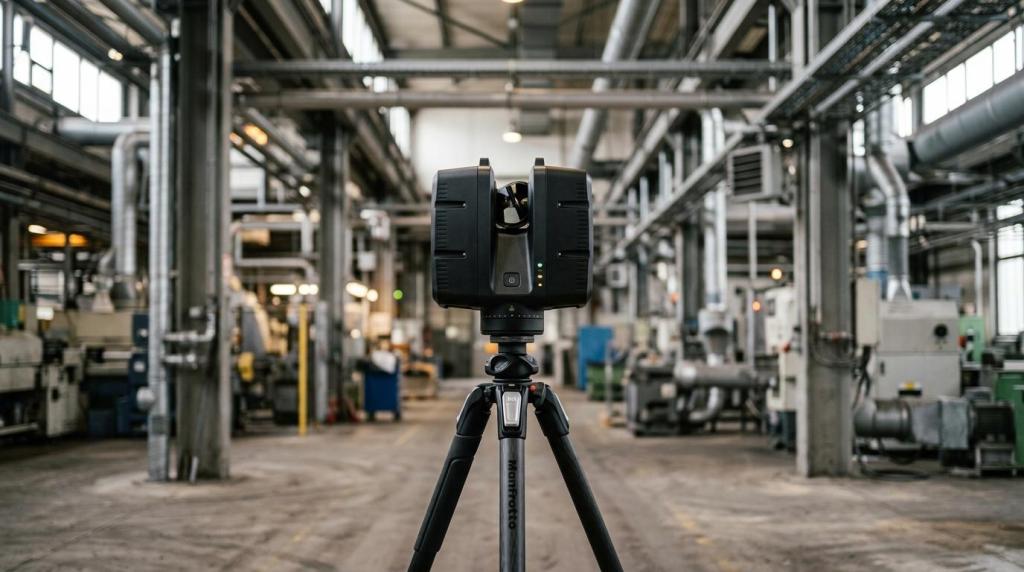
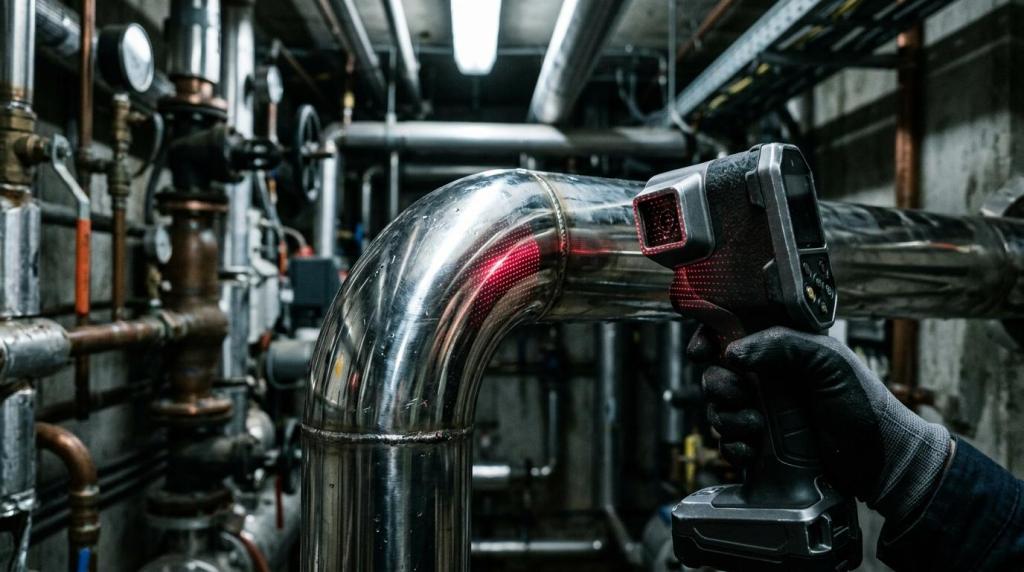
Choosing between 3D scanning services and buying your own scanner is usually less about technical enthusiasm and more about the realistic economics of running it. Many companies initially assume that owning the equipment will bring full control, speed and lower costs. That is only true when it is clear what will be scanned, how often, to what accuracy, and who will actually work with the data afterwards.
In 3D scanning, a cheaper device does not automatically replace a specialist service. What counts is accuracy, repeatability, object size, surface, material, the link to CAD/BIM and how much time it takes to learn the whole process properly. For irregular jobs or very varied parts, ordering a service tends to be the safer choice. Your own scanner only starts to make real sense where measuring is frequent, repeatable and well embedded in the company workflow.
3D scanning services vs your own 3D scanner: what decides
The first question is not “which scanner should we buy” but “what output do we need”. Some need only a point cloud, others a polygon mesh, others an accurate CAD model for reverse engineering, an inspection report or BIM data for building documentation. Only then does it make sense to choose the technology.
The second aspect is the object itself. In professional work, the choice of technology is usually driven by three basic parameters: part size, material properties and required accuracy. This applies to small machine components as well as entire buildings. Dark, shiny, transparent or complex surfaces are scanned differently from matte, simple shapes. Likewise, inspecting a product with tolerances is a different task from quickly digitising a space.
These are the factors that most often tip the balance:
- frequency of use
- required accuracy and repeatability
- size and complexity of the object
- type of output for CAD, BIM or inspection
- team capacity and time for training
- service, calibration and running costs
The last two points in particular tend to be underestimated at the time of purchase. The scanner itself is only part of the investment. Just as important are the software, a powerful computer, the scanning methodology, data processing and a person who can tell when the result is really accurate enough for further use.
When 3D scanning services make sense
A 3D scanning service is usually the best choice when a company scans irregularly, deals with a different type of part every time or needs a high degree of certainty that the right method is used from day one. This applies to manufacturing, architecture, construction and heritage conservation alike. Instead of investing in equipment and training, you pay for a specific deliverable.
A major advantage of a service is access to multiple technologies. One project may call for a handheld laser scanner, another for structured light and yet another for SLAM LiDAR for large interiors or sites. If a company buys one all-round device, it often soon discovers that versatility has its limits. Not every scanner can handle a small detail, a large object and metrology with the same quality.
Another point comes up regularly: a lower purchase price does not mean the same accuracy and repeatability on complex surfaces. Comparative studies point out that the difference between cheaper and more expensive scanners shows mainly in systematic error, and that repeatability on freeform surfaces tends to be considerably worse than on simple reference shapes. If the output is meant for quality control or reverse engineering, this is a fundamental difference.
Outsourced 3D scanning typically pays off in these situations:
- Irregular use: you scan only a few times a year or depending on current orders
- Varied objects: one time a production part, the next a machine, then part of a building
- Demanding outputs: you need an inspection report, CAD data, a mesh or a BIM model
- Tight deadline: there is no time for training, testing and finding the right method
- Limited in-house capacity: the team has no one to look after scanning in the long term
If you want to verify your real needs first, it makes sense to start with 3D scanning services. Only once several projects show a stable workload is it worth calculating the case for your own equipment.
When is a 3D scanner worth buying?
Your own scanner becomes a powerful tool once scanning is a regular part of the process. This is typical for manufacturers who repeatedly inspect similar parts, engineering teams that do frequent reverse engineering, or facility managers who digitise a building portfolio over the long term.
It is not just about saving money on external services. Speed of response matters too. If a technician can scan a part right after production or on receipt from a supplier, the company gets a shorter loop between measurement, evaluation and correction. In-house use also makes it easier to build a standardised procedure, report templates and the link to CAD/PDM.

Owning a device makes economic sense mainly when its utilisation can be calculated reliably. If the scanner is used every week, ideally several times a week, the investment is spread across more projects. At that point it is important that the specifications match the specific task and that the team can handle the whole chain from capture to final data.
For smaller and more mobile applications, compact hybrid models now help as well. They show that the market is moving towards faster deployment without complex preparation. One example is EinScan Rigil, which represents the trend towards wireless, flexible scanning in the workshop and in the field. Mobility alone, however, still does not tell you whether a particular device is suitable for the required accuracy and surface type.
Accuracy, repeatability and material in 3D scanning
When choosing a 3D scanner, people often talk about speed and data density. In engineering practice, though, accuracy and repeatability usually matter more. In metrology applications, conformity with tolerances takes priority over how “nice” a dense point cloud looks. This is worth keeping in mind especially when comparing the marketing specifications of different devices.
Material and surface are also essential. Shiny metals, dark materials or transparent parts may require a different capture strategy, temporary surface treatment or a different type of scanner altogether. Small parts with fine details usually call for a different technology than large structures, interiors and buildings.
This is where the difference between a service and ownership becomes clear. A specialised provider routinely selects the technology to suit the task. A company with a single scanner tends to adapt the brief to what the device can do, instead of looking for the best route to the required result.
The following overview shows how the decision usually changes depending on the application:
| Application | Typical object | Key requirement | Often the better choice |
|---|---|---|---|
| Reverse engineering of smaller parts | components, castings, moulds | detail, accuracy, clean mesh | own scanner if used frequently |
| Quality control in production | repeated series | repeatability, reports, link to GD&T | own scanner with a stable process |
| One-off technical measurement | atypical parts, prototypes | choosing the right technology | scanning service |
| Scanning buildings and halls | interiors, facades, plants | capture speed, spatial orientation | service or a dedicated construction solution |
| Building documentation and facility management | sites, plant rooms | data scope, BIM integration | depends on project volume |
| Heritage conservation | complex and sensitive objects | fine details, safe procedure | more often a scanning service |
3D scanning in construction and SLAM LiDAR scanners
For buildings, sites and larger interiors, the decision shifts. Here it is often not about hundredths of a millimetre, but about capturing a large space quickly and reliably. That is why SLAM LiDAR scanners are growing in popularity: they let you move through a building without time-consuming setup of stations and can very quickly create a point cloud for building documentation, BIM or asset management.
If a company digitises buildings only occasionally, ordering a service is usually more cost-effective. But if it manages a larger building portfolio, regularly surveys buildings before renovation or produces data for facility management, its own SLAM LiDAR can be very well justified economically. At that point it is no longer just about the device, but also about the workflow for data cleaning, registration, export and integration with design tools.
As an additional source for this topic, it is worth following Techcad.cz, which covers construction digitalisation and its links to CAD/BIM practice. For construction scanners themselves, FJD Trion is also relevant, focusing on SLAM LiDAR solutions for fast mapping of interiors, buildings and outdoor areas.
Hidden costs of owning a 3D scanner
The purchase price is only the first number in the spreadsheet. In practice, the total cost of ownership is what counts. For some companies, this is precisely why the investment pays back more slowly than expected. Even publicly available cost-benefit analyses from other industries show that adoption costs can slow down a return on investment considerably.

The calculation should include not only the hardware, but everything around it:
- Software: licences for capture, inspection, meshing, reverse modelling or BIM export
- Training: operator time, measurement methodology, data evaluation
- Service: calibration, support, possible equipment downtime
- Supporting hardware: laptop, workstation, storage, batteries, accessories
- Consumables: markers, sprays, tripods, transport cases
- Process costs: who cleans the data, who approves it and who converts it to CAD
Software in particular is often overlooked. A point cloud or mesh on its own is not yet a finished result for production or design. If the output is to be a usable CAD model, an inspection report or data for SOLIDWORKS, Revit or Archicad, follow-up tools and experience become much more important. For reverse engineering, integration with tools such as QuickSurface may be relevant; for design automation, the wider environment of CAD automation and configuration.
How to calculate the return on a 3D scanner investment
The decision can be made surprisingly soberly. Simply compare the annual cost of external services with the annual cost of running your own device: not only the purchase, but also training, licences, service and people's time. If running your own comes out cheaper and also speeds up processes, that is a good sign. If the difference is small, staying with a service is usually the safer option.
A practical approach might look like this:
- Add up the job volume: how many times a year you actually need to scan and how varied the objects are.
- Define the required output: mesh, CAD, BIM, inspection, archiving or just indicative data.
- Calculate the full annual cost of ownership: depreciation, software, service, training, operator time.
- Compare the risk of errors: what a badly scanned part, a wrong report or a repeat measurement costs.
- Consider a pilot phase: a few months of services or a loan device often reveal more than catalogue specifications.
It also helps to distinguish whether you are looking for an all-round solution or a specialised tool. An all-round scanner is convenient to start with but may hit its limits in high-precision tasks. A specialised solution, on the other hand, may not suit everything that comes along in six months.
Questions to ask before buying a 3D scanner
Before making a decision, it pays to ask yourself a few very specific questions. The more precise your answers, the lower the risk of buying a device that works technically but makes no business sense.
- What will we scan most often: small parts, shiny surfaces, interiors, machines, buildings?
- How accurate must the data be: visualisation, reverse engineering, quality control, BIM?
- How many times a month will the scanner really be used: occasionally, regularly, every day?
- Who will operate the device: a production technician, a design engineer, a surveyor, an external specialist?
- What data do we need at the end: point cloud, mesh, STEP model, report, documentation?
- Do we have the follow-up software and capacity: or do we need a partner to deliver the complete output?
This set of questions is usually the fastest route to a sensible decision. If most of them do not yet have a clear answer, a 3D scanning service is usually the safer start. If the answers are precise, the workload is stable and the workflow is ready, your own scanner can be a very strong investment in speed, control and independence.
Free download: Checklist: 8 questions to ask before buying a 3D scanner — accuracy, range, software and total cost on a single page.