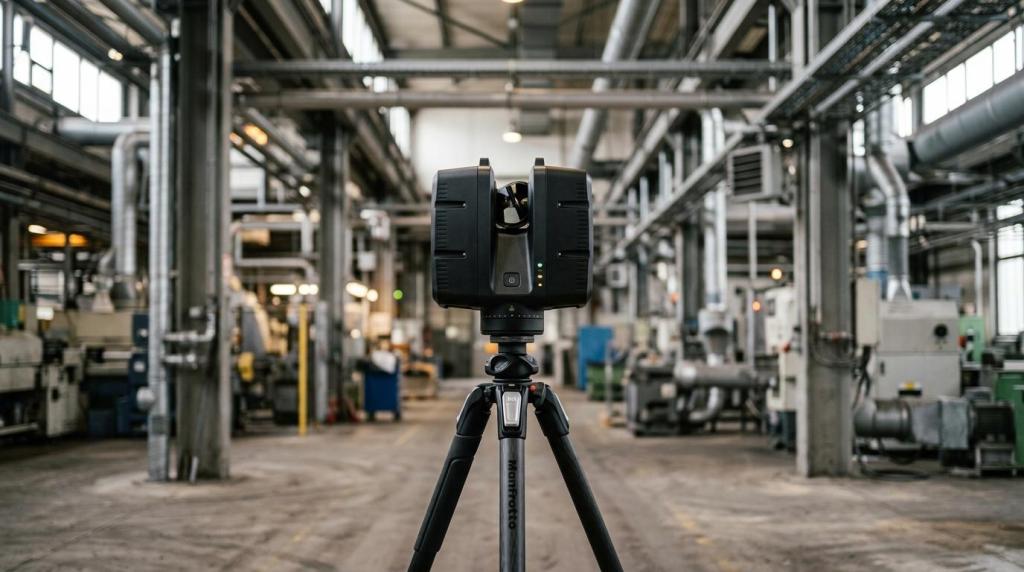
Buying a 3D laser scanner for construction makes sense when you scan often and in larger volumes. For a one-off renovation, a building survey, an as-built check or a short pilot project, however, renting very often wins.
You get modern technology without a large upfront investment and quickly find out whether the data capture itself, working with the point cloud and the follow-up processing into CAD or BIM suit you.
When 3D scanner rental for construction pays off
Renting makes the most sense when you need a scanner for a limited period and know exactly what you want to survey. Typical cases are as-built documentation, scan-to-BIM, deviation checks before equipment installation or the first digitisation of a building for facility management.
In construction, the benefit shows quickly. 3D laser scanning is a contactless, non-destructive method that captures the actual condition of a building with high accuracy. This lets you spot inaccuracies before they turn into costly rework, design changes or delays on site.
Short-term hire is a sensible choice above all in these situations:
- a one-off renovation
- building documentation
- survey of a production hall
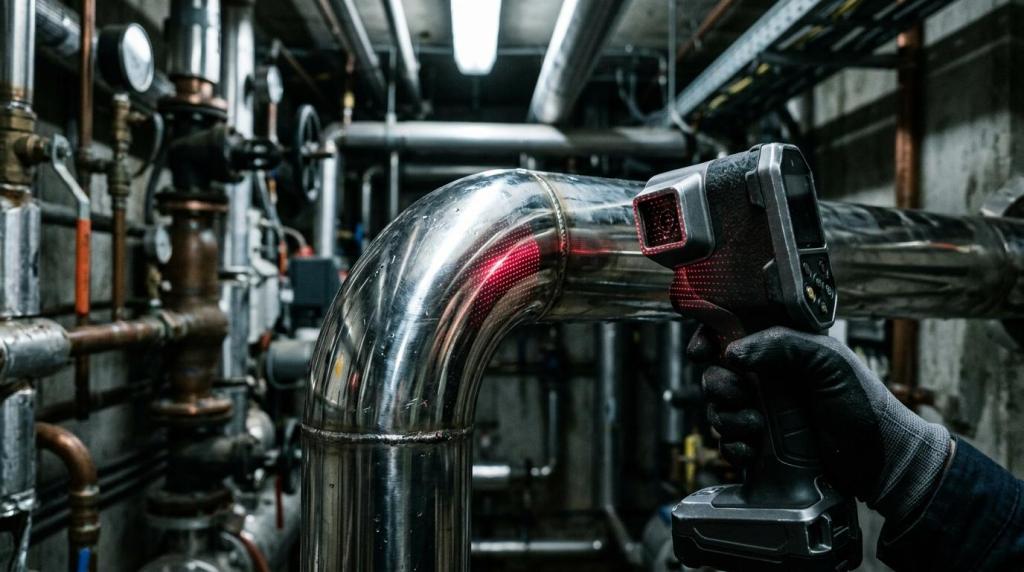
- as-built check of building services
- pilot testing of a new technology
- a tight deadline between survey and handover of documentation
Renting also works well when you want to compare a static scanner with a mobile SLAM LiDAR scanner. With mobile systems such as the Geomate GS60, Trion P2 or Trion S2, a big advantage is how quickly you can walk through interiors, corridors, plant rooms or complex operating areas without constantly setting up a tripod.
What hiring a 3D scanner for a construction site involves
Picking up the device is only the first step. With a construction scanner, you need to sort out dates, the contract, the deposit, the condition of accessories, software, output formats and how the device is returned. Some offers include basic training as part of the hire, others do not.
That is often the decisive difference between a smooth job and a lost day on site.
Expect the rental company to ask for a refundable deposit. For more expensive devices, this is typically tens of thousands of CZK, sometimes more. The terms usually include a completeness check of the kit on return, an assessment of any damage and billing for the actual rental period.
A quick check of what you are actually receiving should be standard at pick-up. The scanner alone is not enough. Batteries, chargers, mounts, a tablet or phone with the app, a tripod, a transport case and, where applicable, licences for the software and export tools all matter.
If you want to make the most of the rental, ask for an exact description of the workflow in advance. There is no room for improvisation on a construction site.
Which 3D laser scanner specifications to check before renting
A 3D laser scanner for construction is not chosen on the daily rate alone. What matters most is whether it can handle your specific type of building and whether the data open without complications in the tools you already use. Scanning a small room, a multi-storey office building, a historic building or the equipment in a boiler room are very different tasks.
If your work continues in BIM, design or facility management, it pays to check compatibility with your software and output formats in advance. For follow-up work with CAD and BIM data, related materials on Techcad.cz and the services around 3D scanning of buildings, which cover converting point clouds into practical models, are also worth a look.
Before you book a device, ask mainly about these points:
- Accuracy and range: does the scanner match the output quality required for the design, the building record or the installation check
- Software and export: will you get the data in common formats for Revit, AutoCAD, Archicad or other BIM tools
- Mobility on site: is a static scanner more suitable, or a mobile SLAM LiDAR for walking quickly through the building
- Battery life: will it cover one survey without frequent recharging and downtime
- Operator training: is a short briefing, a field demo and basic advice on data capture included
- Data processing after the scan: does the rental include registration and cleaning of the point cloud, or just the hardware
With mobile construction scanners, it is especially important how data registration and completeness checks are handled in the field. If part of a corridor, a machine room or a ceiling structure is missing, you often only notice back in the office – and by then it is usually too late.
How much does 3D scanner rental for construction cost?
The price varies with the device class, the rental period and the scope of services. There is also a difference between a simple scanner for small objects and a professional construction solution for surveying buildings.
Offers on the market vary widely. For smaller 3D scanners you can find rentals at a few hundred CZK per week, but construction devices typically cost thousands to tens of thousands of CZK per day. A deposit is often added, and sometimes also a charge for insurance, training or a licence.
| Device type | Example from the market | Deposit and terms | Note |
|---|---|---|---|
| Smaller 3D scanner for objects | CZK 500 / week | deposit CZK 14,999, return of the complete device | better suited to small objects, not buildings |
| High-end 3D laser scanner for construction | CZK 15,125 / day incl. VAT | deposit CZK 40,000, rental agreement | suitable for professional surveying |
| Mobile SLAM LiDAR scanner | usually an individual quote | often depends on equipment, dates and support | often decided by whether training and software are included |
The table clearly shows that the daily rate is not the only cost.
 You also need to factor in operator time, travel, site preparation, data processing and sometimes a repeat visit to the building.
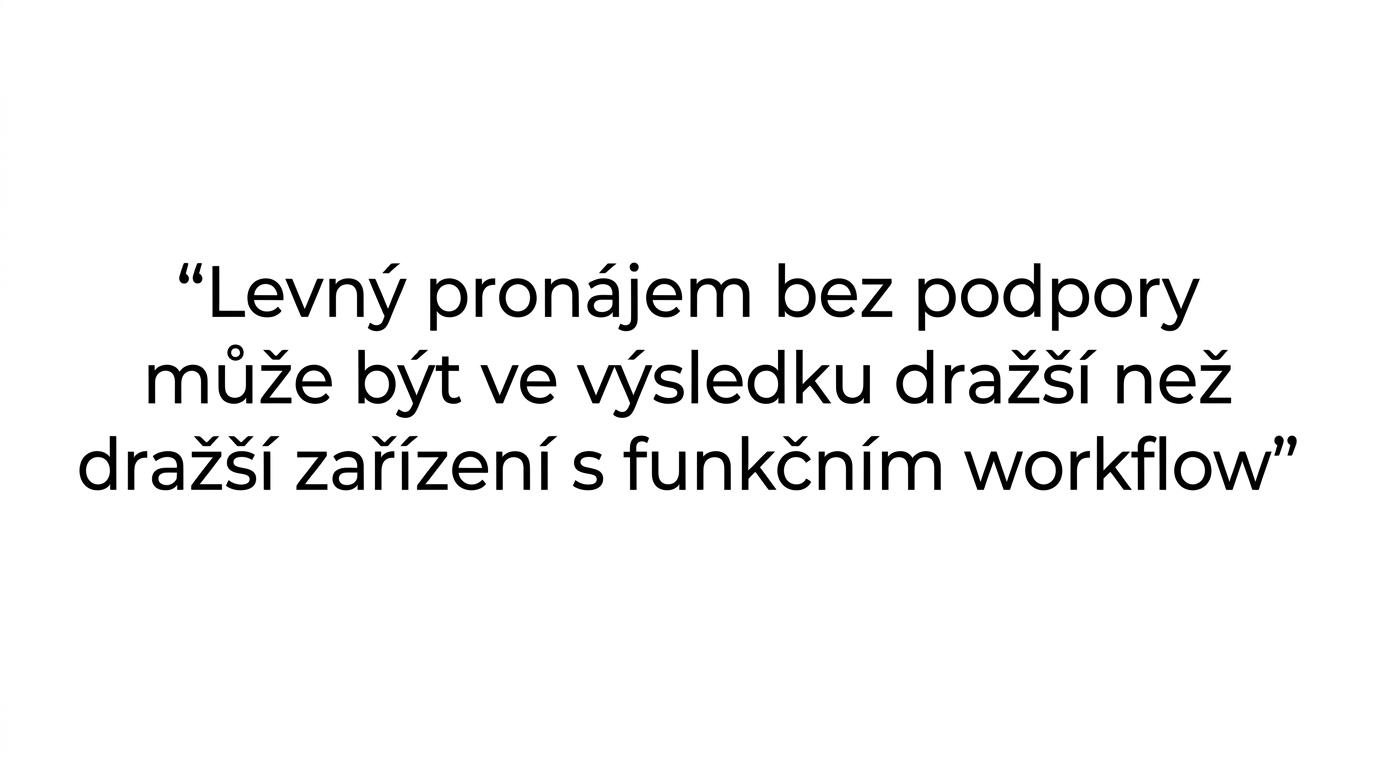
A cheap rental without support can end up costing more than a more expensive device with a working workflow.
3D scanning workflow on a construction site: from pick-up to point cloud
With a rental, the sequence of individual steps is often underestimated. Yet it is the workflow that decides whether you end up with a usable point cloud or just bulky data that will be hard to fix.
In construction, a simple, disciplined procedure works best. You can’t “just switch on” the scanner. You need to think through the route, data overlap, problem areas, people moving around the site and how to check completeness while still in the field.
In practice, the process usually looks like this:
- Pick-up of the device, check of accessories and quick training.
- Preparation of the building and a data capture plan according to the purpose: as-built, building record, BIM or deviation check.
- Scanning in the field with ongoing checks of registration and completeness.
- Transfer of the data to the office, basic cleaning, registration and export of the point cloud.
- Follow-up processing into drawings, a 3D model, a BIM model or documents for facility management.
With static scanners, the field work is usually slower but very stable. With mobile SLAM LiDAR scanners, capture is much faster, but you need to watch for correct movement along the route, links between spaces and registration quality. In buildings in operation, this is often the ideal option because a large area can be captured in a short time.

If you are unsure about the subsequent processing, it pays to rent from a partner who will also help with the workflow that follows, point by point – not just hand over the case.
3D scanner rental for building documentation and reserved technical equipment (VTZ)
In facility management, renting a scanner has very practical uses. It is ideal for documenting a building and digitising machine rooms, boiler rooms, switchboards, service routes, roofs or common areas. Up-to-date 3D documentation then makes it easier to plan maintenance, renovations and operational interventions.
This is especially relevant in connection with Czech Act No. 250/2021 Coll., which tightened the obligations of building managers and operators with regard to reserved technical equipment. If a building contains electrical installations, lightning protection, pressure equipment, gas equipment or lifting equipment, the operator has clear obligations regarding documentation and safe operation.
A 3D scan does not replace these obligations on its own. But it can significantly speed up building documentation, establishing the actual condition and preparing documents for inspections, the local operating safety regulation (MPBP), operating documentation or a renovation.
In practice, it makes sense to combine scanning with these steps:
- Appointing a responsible person: someone has to be responsible for operating the equipment and managing the documentation
- Building documentation and document audit: verify what is actually in the building and what is missing from the records
- Tracking down accompanying documentation: manuals, technical specifications, diagrams, operating data
- Inspections by authorised persons: including a valid licence from TIČR (the Technical Inspection Authority of the Czech Republic) where required
- Archiving operating documentation: inspection reports, repair records, operator training and inspection schedules
With leased or entrusted premises, you also need to consider who the actual operator of the equipment is. In some cases, responsibility for proper use and operation may pass to the tenant from the day the equipment is demonstrably handed over, if the operator is not the owner. That is another reason why up-to-date digital documentation is so valuable.
When to rent and when to order a 3D scanning service
Renting is the right choice when you have your own surveying capacity, know what output you need and want to keep data capture under your own control. This is often the case for design offices, larger construction companies, facility teams and technical departments of industrial sites.
If, however, you need a guaranteed result at short notice, there is no need to rent equipment at any cost. For complex buildings, listed heritage buildings, large technology installations or when an accurate BIM output is required, it is often more practical to order a scanning service including processing straight away.
A sensible decision usually comes down to a simple question: are you buying operator time or certainty of the result?
If you only want to survey a hall, a machine room or an office building once a year, 3D scanner rental for construction is a very strong option. But if you also need the data converted into a model, building documentation or records for managing VTZ, the greatest benefit comes from technology, software, training and processing working seamlessly together.