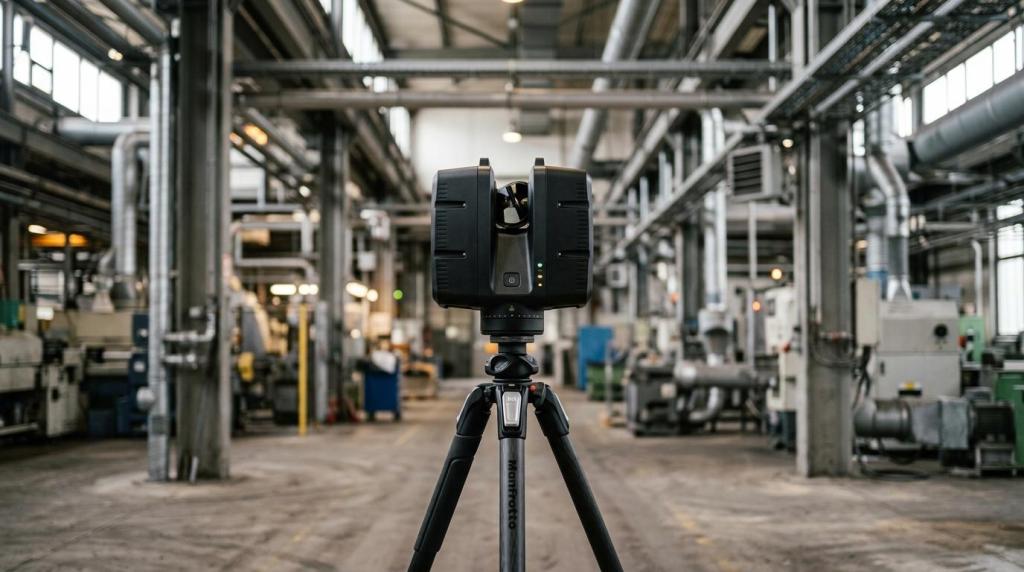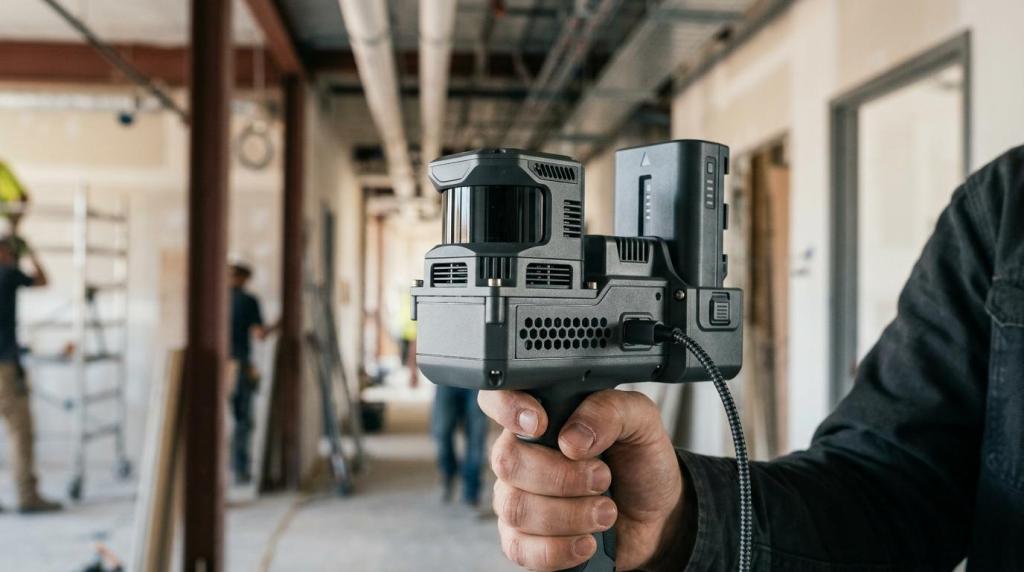
With the FJD Trion P2, the price is more than a line in a price list: it decides how quickly your team captures data on site and how much work it saves back in the office. For Czech construction, design and facility teams, the price only makes sense when you read it together with mobility, accuracy, software and the link to BIM or CAD. 4CAD solution is a Czech supplier of CAD and 3D technologies, which is why with the P2 we look not just at the purchase price but at the whole workflow from scan to deliverable.
Summary
- The FJD Trion P2 price pays off above all where fast mobile data capture by a single operator – with no tripod and no external power supply – is what counts.
- On the Czech market, 4CAD solution lists the P2 at CZK 254,500 excl. VAT, while the version with a thermal camera costs CZK 306,916 excl. VAT.
- The official FJDynamics website gives an indicative price of EUR 5,400 to 6,400, so the final amount depends on the region, the distributor, the accessory bundle and the software.
- The P2 makes the most sense for building documentation, BIM, as-built surveys, facility management and heritage digitisation, where its mobility means fewer site visits and faster processing.
- The scanner price alone is not enough to decide: also consider output to Revit, AutoCAD or Archicad, post-processing, training, the RTK/PPK workflow and how the data will be used in-house.
Differences between price lists are nothing unusual. With SLAM LiDAR scanners for construction, prices routinely vary with the configuration, the local market, VAT, promotional bundles and whether a company is comparing the bare device or a complete solution including software and support. That is exactly why “when does the P2 pay off?” is a more useful question than “what does it cost at first glance?”.
What does the FJD Trion P2 cost in the Czech Republic?
The FJD Trion P2 currently sells in the Czech Republic for CZK 254,500 excl. VAT; 4CAD solution lists this price in its e-shop. The version with a thermal camera costs more and goes above CZK 300 thousand excl. VAT.
The list price of the P2 on its own is CZK 254,500 excl. VAT, i.e. CZK 307,945 incl. VAT. The FJD TRION P2 LiDAR + thermal camera is also offered separately at CZK 306,916 excl. VAT. The higher price of this version comes from the added thermal camera, not from a different price list. For a comparison with other models, see the overview of 3D laser scanners for construction.
The official FJDynamics website also gives an indicative price of EUR 5,400 to 6,400. So if you compare the Czech price with the global range, take the exchange rate, VAT, local service and the scope of delivery into account. Practical tip: for a business decision, compare prices excluding VAT and check exactly what is included in the delivery.
“4CAD solution lists the FJD Trion P2 in its Czech offer at CZK 254,500 excl. VAT, while the version with a thermal camera is priced higher.”
What really drives the FJD Trion P2 price?
The purchase price of the P2 is not just the price of the sensor but the sum of hardware, software, workflow and support. With FJDynamics and with local distributors alike, the amount changes with the bundle, the accessories and the way the scanner will be used in your company.
A common mistake is to count only the box with the scanner. What really matters for the return on investment is whether you only need a point cloud or a complete solution for building documentation, BIM and handing data over to designers.
- Device configuration: the P2 on its own, or the version with a thermal camera.
- Software and post-processing: work in FJD Trion Scan and the follow-up in FJD Trion Model.
- Georeferencing: an RTK/PPK workflow if you need the data tied in more precisely.
- Accessories: batteries, transfer components, transport equipment and any add-ons.
- Supplier services: training, support, a trial project and help with exports to BIM/CAD.
- Commercial terms: region, distributor, VAT and price list updates.
The P2 is supported in FJD Trion Model, which matters most when you don’t want to stop at data capture but need cleaning, modelling and deliverables for further professional work. Once the required outputs get more complex, the software stops being an “extra” and becomes part of the real price of the solution.
Which companies benefit most from the FJD Trion P2?
Experience from the Czech market shows that the FJD Trion P2 makes the most sense for companies that frequently scan buildings, interiors or smaller sites and need a mobile workflow. That is why 4CAD solution positions it in the context of building documentation, BIM, design and construction digitisation.
Mobility is the strongest argument for the P2. The official data quote a weight of around 700 g, a speed of up to 200,000 points per second and a runtime of up to 4 hours with the dual battery. That is exactly the combination that helps wherever a heavier or less agile system would mean more set-ups, more people on site and more repeat visits.
Companies working on as-built documentation, renovations, building records, property management or heritage documentation benefit the most. In facility management, the legal context also plays a role. Czech Act No. 250/2021 Coll. tightened the obligations of building managers and operators with regard to reserved technical equipment (VTZ). A scanner does not replace statutory inspections or the local operating safety regulation, but it helps a great deal with building documentation, documentation audits and producing records of the as-built condition of a building.
If you deal with electrical installations, switchboards, boiler rooms, gas distribution, pressure equipment or lifts, fast capture of the building geometry and plant rooms can shorten the time needed to prepare documentation. If, on the other hand, you only scan a few times a year, it may be more economical to outsource the service.
What are the main use cases of the FJD Trion P2 in companies?
The P2 is at its strongest where data need to be captured on the move and the point cloud has to be usable right away. Typical areas are construction, BIM, facility management, surveying support and documentation of existing conditions.
It is not only about the industry but about the type of job. When a building has to be covered quickly, in tight spaces and with a small team, the benefit of the P2 grows.
- Building documentation: an up-to-date basis for drawings, the BIM model and asset management.
- As-built after renovation: checking what was actually built against the design.
- Facility and plant room management: machine rooms, shafts, corridors, distribution lines and service routes.
- Heritage sites and historic buildings: fast capture of geometrically complex spaces and details.
- Construction sites and development projects: ongoing documentation before structures are covered up.
- Forensic and special documentation: situations where speed matters and time on site is limited.
An FJDynamics case study from heritage digitisation is also worth a look: a building was scanned by a single operator in 10 minutes. That is not a universal time for every project, but it shows well why a handheld SLAM LiDAR scanner is so attractive wherever responsiveness is decisive.
“According to the specifications used by 4CAD solution, the FJD Trion P2 weighs around 700 g and captures up to 200,000 points per second.”
How to calculate the return on investment in the P2, step by step
The payback of the P2 is calculated from time saved, fewer site visits and faster production of billable deliverables. If your company wins this kind of work repeatedly, the economics of the scanner look far better than with occasional use.
Step 1 is to quantify the workload. How many buildings do you survey per month, how often do you return to site and how many people take part in field data capture? If your current process means two people, several visits and manual follow-up measurements, the P2 starts from a strong position.
Step 2 is to recalculate the whole chain, not just the scanning. A common mistake is to look only at the time spent on site. The calculation should also include sorting photos, additional measurements, redrawing in CAD, missing dimensions and design corrections caused by incomplete data. If a single overlooked detail sends you back to the building, the hidden cost grows fast.
Step 3 is to define which deliverable you sell or use internally. If the P2 speeds up the production of a building record, a BIM model, renovation drawings or documents for technical facility management, the return is measurable. If the data just “sit on a drive”, the investment naturally pays back more slowly.
How to roll out the FJD Trion P2, step by step
The fastest rollout of the P2 starts with a pilot project, a clearly defined deliverable and properly set up FJD Trion Scan and FJD Trion Model software. Without a defined goal, even a good scanner can end up as an expensive measuring tool with no workflow.
First, choose a representative building. Ideally, it should combine interiors, plant rooms and ordinary building elements. The pilot will show whether a basic point cloud is enough for you or whether you need cleaning, segmentation and follow-up modelling.
Then define exactly what the deliverable should be. For a designer, it may be a basis for Revit, AutoCAD or Archicad. For a facility manager, a record of rooms, service routes and plant rooms. For an investor, as-built documentation for the next project phases. If the deliverable is not named in advance, the team often captures more data than it actually needs.
Finally, set internal rules: who scans, who checks completeness, who does the post-processing and who is responsible for archiving the data. This is especially important in facility management, where building documentation helps link up the operating documents but does not replace statutory inspections, operator training or the records required for VTZ.
How to make sure your company gets the full accuracy and speed of the P2
The P2 can be highly efficient, but only with the right scanning procedure, route control and sensible post-processing. A figure of 200,000 points per second or an accuracy of around 1.2 cm does not by itself guarantee a flawless result in every situation.
Start by assessing the type of environment. Interiors with passages, corridors and repetitive elements require a different walking strategy than open outdoor space. If the routes form closed loops and the individual passes overlap, SLAM usually works more reliably.
The second check is the relationship between expected accuracy and the purpose of the data. A common mistake is to read the 1.2 cm figure as the same certainty for every point in every environment. Accuracy depends on the workflow, the conditions and the post-processing. If you need higher positional certainty in relation to map data, an RTK/PPK solution makes sense.
The third check is data density. For a selected application, FJDynamics quotes HyperDense+ with 5 to 7 times denser data and a point spacing down to 1 mm. That is a powerful tool, but it cannot fill in missing viewpoints. Practical tip: a denser point cloud will not make up for a poorly planned scanning route.
Is the FJD Trion P2 a better choice than the cheaper FJD Trion V4e?
If the entry price is your main criterion, the V4e is considerably cheaper in the Czech offer. If mobility, handheld work in the field and greater ease of use are key, the P2 usually makes more business sense.
Czech prices put the V4e LiDAR Kit at around CZK 127,500 excl. VAT, while the P2 costs roughly twice as much. That alone does not make the P2 “overpriced”. It means you need to name exactly what you are paying extra for. With the P2, it is mainly the way it is used and its position as a lightweight handheld SLAM LiDAR scanner for construction, BIM and building documentation.
If you are only taking your first steps in 3D scanning and the volume of work is small, a lower purchase price may be the sensible choice. But if your team needs to scan often, fast and on the move, the more expensive device can turn out cheaper per project.
When does the FJD Trion S2 make more sense than the P2?
The P2 offers the better price-to-mobility ratio, while the S2 sits in a higher price bracket and should be assessed as a step into a different class of solution. Without a precise project brief, you cannot say that the S2 is automatically better.
In the Czech offer, the FJD TRION S2 SERIES LiDAR scanner costs around CZK 468,900 excl. VAT, well above the P2. That forces you to ask whether you will really use a more expensive class of device or whether you rather need a lightweight everyday tool for operational scanning of buildings and construction sites.
A good rule of thumb is simple. If responsiveness, one person in the field and fast building documentation are the main requirements, the P2 is usually a very strong candidate. If you are aiming at a more demanding portfolio, bigger budgets and more specific technical requirements, it makes sense to compare higher-end models as well, including the link to FJD Trion Model Web and the subsequent BIM workflow.
Limitations and common mistakes to know before you buy
The FJD Trion P2 is a powerful mobile scanner, but it is not a universal replacement for every surveying or design method. Most mistakes come from overestimating range, confusing SLAM accuracy with absolute geodetic accuracy and underestimating data processing.
The first mistake concerns range. FJDynamics specifies a range of 70 m for the P2 at 80% surface reflectivity and 40 m at 10% reflectivity. The figures of 40 m and 70 m therefore do not contradict each other; the difference lies in how reflective the scanned surface is. For a purchase decision, it is better to ask about the performance you can routinely achieve in your own scenarios than about the maximum laboratory figure.
The second mistake is a legal one. The P2 can serve very well for building documentation, an audit of the as-built condition or preparing documents for facility management, but on its own it does not fulfil the statutory obligations of a VTZ operator. If the accompanying documentation in Czech is missing, it has to be tracked down or a local operating safety regulation (MPBP) has to be drawn up. Inspections must still be carried out by authorised persons holding a valid licence from TIČR, the Technical Inspection Authority of the Czech Republic.
The third mistake concerns the process. The scanner is not the goal but a source of data. Anyone who does not sort out exports, the structure of point clouds, responsibility for archiving and the link to CAD/BIM will usually not achieve the expected return. For a broader comparison of SLAM scanners for construction and related workflows, the expert materials on Techcad.cz are also worth following, especially if you are choosing between several types of device while also dealing with building documentation or construction digitisation.